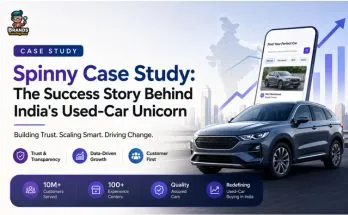
A buyer hands over cash for a used sedan that looks clean and well kept. Three weeks later, a mechanic finds accident damage the seller never mentioned, and the odometer reading turns out to be fiction. This was a common outcome in India’s used car market before 2015, the year three IIT Delhi and IMT Ghaziabad graduates decided to build a company that could put its name behind every car it sold. This Spinny case study covers exactly how that decision grew into a business that sells thousands of cars a month, has raised more than $700 million from global investors, and counts cricket legend Sachin Tendulkar among its backers, along with honest answers to the questions people search for most, including whether Spinny is profitable and who runs the company today.
Spinny Case Study: Company Snapshot
| Founded | 2015, in Delhi NCR |
| Founders | Niraj Singh, Ramanshu Mahaur, Mohit Gupta |
| Headquarters | Gurugram, Haryana |
| CEO | Niraj Singh |
| Sector | Full-stack pre-owned car retail |
| Presence | 22+ cities, 36+ car hubs (FY25 filings) |
| Total funding raised | Over $700 million across multiple rounds |
| Valuation | Reported in the $1.4 billion to $1.8 billion range, depending on the round and source, since reaching unicorn status in 2021 |
| FY25 revenue | ₹4,657 crore, up 25% year-on-year |
| FY25 net loss | ₹423.8 crore, down 28% year-on-year |
| Notable investors | Tiger Global, Accel, Elevation Capital, General Catalyst, Avenir Growth, WestBridge Capital, Fundamentum, Fidelity Investments, Sachin Tendulkar |
Buying a used car in India has traditionally meant negotiating with a local dealer who controls almost all the information: how many accidents the car survived, whether the odometer reading is real, and whether the paperwork is clean. For a market moving millions of vehicles a year, that information gap kept prices unpredictable and buyers nervous, a sharp contrast to the trust that companies like Tata Motors have spent decades building around new-car ownership.
Niraj Singh had already tried to fix a related problem once before. His earlier ventures, Locus Education and TechMonkey, did not survive past a few years each, but they taught him how to build and shut down a product quickly when the market says no. By 2015, he, Ramanshu Mahaur, and Mohit Gupta decided the real opportunity was not in connecting buyers and sellers, but in owning the entire transaction: inspecting the car, certifying it, pricing it fairly, and standing behind the sale.
The Idea Behind Spinny: Why a Full-Stack Model
Spinny’s founding team split responsibilities along their own strengths. Niraj Singh, an IIT Delhi graduate who had also worked as a founding partner at Outbox Ventures, took on the CEO role and the investor-facing side of the business. Ramanshu Mahaur, an IIT Delhi computer science graduate who had spent close to five years at Adobe, became the company’s technology lead. Mohit Gupta, who had worked at Flipkart between 2011 and 2014, took charge of operations.
Their core decision was to avoid the classifieds model used by most listing sites at the time, where the platform simply connects a buyer and a seller and steps away. Instead, Spinny built what it calls a full-stack model: the company buys the car from the seller, runs it through an internal inspection process, reconditions it if needed, prices it, and sells it directly to the buyer under its own name. That meant Spinny, not an anonymous third party, was accountable if something went wrong.
The company began operations in Delhi NCR in June 2015 and expanded to Bangalore soon after. According to Spinny’s own account of its early days, the founders were working with a small team and a simple goal: bring transparency and honesty to a transaction that badly needed both.
The Journey: How Spinny Grew, Year by Year
- 2015: Spinny launches in Delhi NCR with a peer-to-peer style inspection service before expanding to Bangalore.
- 2017: The company pivots to the full-stack retail model it is known for today, buying, certifying, and reselling cars directly rather than only listing them.
- 2020: Spinny raises a $43.7 million Series B round led by Nandan Nilekani’s Fundamentum, then acquires Mumbai-based rival Truebil in August, one of the first consolidations in India’s organised used-car segment.
- 2021: Spinny raises $283 million in a round led by Tiger Global, crossing a valuation of roughly $1.8 billion and entering the unicorn club.
- 2022 to 2024: The company scales its car hub network across 22-plus cities, builds out its own financing and warranty programmes, and works to narrow its losses as revenue grows.
- 2025: Spinny closes a Series F round, first at $131 million in March led by Accel Leaders Fund, then expanded to $170 million in June with WestBridge Capital joining. FY25 filings show revenue of ₹4,657 crore and a narrowed net loss of ₹423.8 crore. The company also rolls out a 3-year warranty option on select cars and expands into car servicing.
- Late 2025 into 2026: Spinny raises a Series G round of roughly $160 to 165 million, co-led by Accel, to fund the acquisition of car servicing chain GoMechanic, alongside a separate secondary share sale.
How Spinny’s Business Actually Works
Spinny’s process is built around three commitments that show up repeatedly in its marketing and, more importantly, in its actual terms and conditions:
- A 200-point inspection: Every car sold as “Spinny Assured” goes through a documented inspection covering the engine, structure, electricals, and paperwork before it is listed.
- A 5-day money-back guarantee: Buyers can return a Spinny Assured car within 5 days of delivery for a full refund, as long as it has not been driven more than 300 km and has not been damaged, repaired, or modified in that window.
- A 1-year comprehensive warranty: Every Spinny Assured car comes with a standard one-year service warranty, with a 3-year option introduced on select cars in 2025 (longer than the standard warranty offered by rivals like Cars24 or Maruti True Value at the time).
On the revenue side, the used car sales themselves make up almost all of Spinny’s income (97.7% of operating revenue in FY25), with the rest coming from commissions, support services, and, more recently, advertising on its platform. The company has also moved into financing through its own NBFC subsidiary and, with the GoMechanic acquisition, into car servicing, both natural extensions of a full-stack model built around owning the customer relationship end to end, the same instinct that led Porter to rebuild intra-city logistics around owning execution rather than just listing it.
The Funding Journey and Key Investors
Spinny’s investor base has grown from early venture backers to a mix of global growth funds and one well-known individual investor.
| Round | Approximate Size | Key Investors |
|---|---|---|
| Series B (2020) | $43.7 million | Fundamentum, General Catalyst, SAIF, Alteria |
| Series E (2021) | $283 million | Tiger Global, Avenir Growth, General Catalyst |
| Series F (2025) | $131 million, expanded to $170 million | Accel Leaders Fund, WestBridge Capital |
| Series G (2025 to 2026) | Approximately $160 to 165 million, plus a separate secondary sale | Accel, Fidelity Investments, WestBridge Capital |
Cricketer Sachin Tendulkar is a confirmed strategic investor in Spinny and has also served as a brand ambassador for the company, alongside badminton player PV Sindhu. Tiger Global and Accel remain among Spinny’s largest shareholders across these rounds, and Spinny’s pace of fundraising tracks with 2025’s broader shifts in startup funding, putting it alongside fellow homegrown mobility unicorns such as Rapido in attracting late-stage capital.
Revenue, Losses, and the Road to Profitability
Spinny’s FY25 filings with the Registrar of Companies tell the story of a company still spending more than it earns, but by a shrinking margin. Revenue from operations climbed 25% year-on-year to ₹4,657 crore, up from ₹3,730 crore in FY24, while the net loss narrowed by 28.3% to ₹423.8 crore, down from ₹590.3 crore the year before. Total expenses came in at ₹5,170 crore against total income of ₹4,746 crore, with the gap closing on a mix of revenue growth, tighter advertising spend, and better cost control rather than any single one-off gain. Spinny has previously said it expects its more mature markets, including Delhi and Bengaluru, to turn cash-flow positive first, and FY25’s numbers support that direction, though the company has not reached profitability at a consolidated level yet.
What the Spinny Story Teaches Other Founders
Own the hard part of the transaction. Spinny’s decision to buy, certify, and resell cars directly, rather than simply listing them, is what let it make a credible trust guarantee. A marketplace that never touches the product struggles to make the same promise.
Early failures can be useful data. Niraj Singh’s first two ventures did not work out, but both taught him how used-car buyers actually behave, informing the risk controls Spinny later built around returns and warranties.
Growth and losses can narrow together. Spinny’s FY25 numbers show a company still operating at a loss while cutting that loss by nearly a third on rising revenue, a more realistic picture of scaling a capital-intensive business than a straight-line path to profit.
Consolidation is part of the playbook. The acquisitions of Truebil in 2020 and GoMechanic more recently show a company using funding rounds not just to grow organically, but to buy capability and market share directly.
What’s Next for Spinny
Spinny’s most recent moves point toward a broader platform rather than just a car-selling site. The Series G round, structured partly around financing the GoMechanic acquisition, extends Spinny into car servicing, on top of the financing arm it has already built through its NBFC subsidiary. Some market observers have pointed to the company’s fundraising pattern, including a secondary share sale that let early investors exit, as groundwork for a future public listing, a path other Indian consumer startups such as Lenskart have already walked, though Spinny has not confirmed any IPO timeline. For now, the company’s own numbers suggest its near-term priority is straightforward: keep growing revenue faster than costs until the loss column turns positive.
That is the full picture behind this Spinny case study: a founding team that chose to own the messiest part of a broken transaction, a decade of funding rounds and acquisitions to back that decision up, and a business that is still working its way to profit rather than pretending it has already arrived.
That is the full picture behind this Spinny case study: a founding team that chose to own the messiest part of a broken transaction, a decade of funding rounds and acquisitions to back that decision up, and a business that is still working its way to profit rather than pretending it has already arrived.
Frequently Asked Questions
When was Spinny founded and who founded it?
Spinny was founded in 2015 in Delhi NCR by Niraj Singh, Ramanshu Mahaur, and Mohit Gupta.
What is Spinny’s full-stack model?
It means Spinny buys, inspects, reconditions, and resells cars under its own name, rather than only listing cars for third-party sellers.
How much money has Spinny raised in total?
Spinny has raised more than $700 million across multiple funding rounds since 2015, from investors including Tiger Global, Accel, Elevation Capital, and Sachin Tendulkar.
What is Spinny’s 5-day money-back guarantee?
Buyers of a Spinny Assured car can request a full refund within 5 days of delivery, provided the car has not been driven more than 300 km and has not been damaged, repaired, or modified during that period.
Is Spinny profitable?
Not yet at a consolidated level. FY25 filings show a net loss of ₹423.8 crore, down 28% from the prior year, on revenue of ₹4,657 crore.
Who is the CEO of Spinny?
Niraj Singh, one of Spinny’s three co-founders, is the company’s CEO and has held the role since it launched in 2015.
Is Sachin Tendulkar invested in Spinny?
Yes. Sachin Tendulkar is a confirmed strategic investor in Spinny and also serves as a brand ambassador for the company.
Related Case Studies :
The Whole Truth Foods case study: how a clean-label D2C brand built trust in a different consumer category.
Mokobara’s case study: another founder-led brand betting on product quality over discounting.