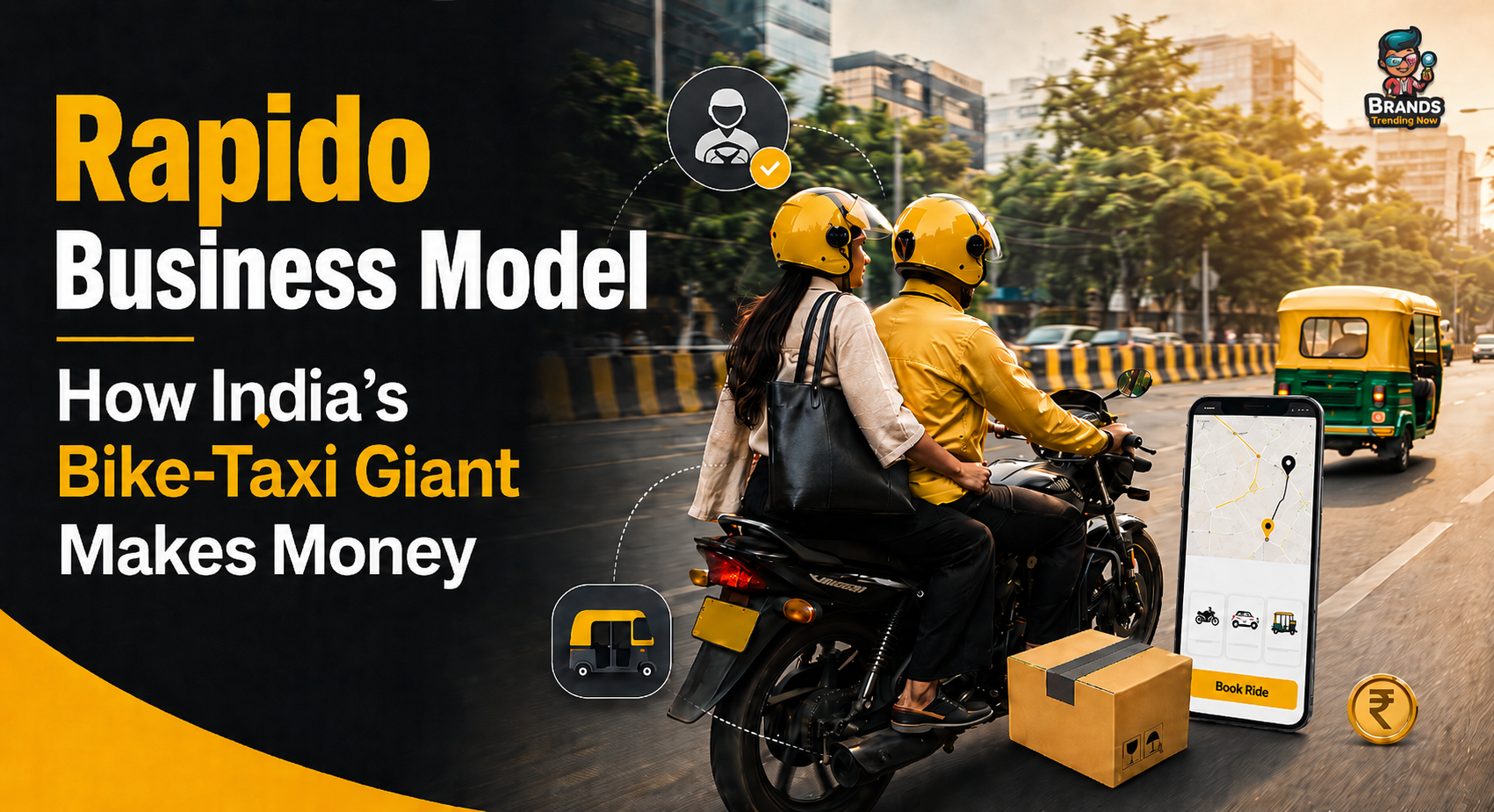
Every morning, in cities from Bengaluru to Lucknow, millions of Indians open one app, tap a button, and within minutes a bike pulls up to take them to work, college, or the nearest metro station. That app is usually Rapido, and behind that simple transaction sits one of India’s most closely watched mobility business models. The Rapido business model has quietly become one of India’s most-watched case studies in mobility.
Rapido started in 2015 as a bike-taxi aggregator in Bengaluru. A decade later, it operates in more than 100 Indian cities, works with over 2 million driver-partners called “Captains,” and according to its FY25 financial filings, crossed the ₹1,000 crore income mark for the first time, with net losses narrowing sharply along the way.
What makes Rapido genuinely interesting for anyone studying business models is how much it has changed shape in just three years. It started as a bike-taxi app. By FY23, delivery had become its biggest revenue stream. By FY25, subscriptions from drivers had grown into a major pillar too, while ride-hailing commissions actually shrank. This article breaks down how Rapido’s business model works, where the money comes from, how it compares to Uber and Ola, and what the latest numbers tell us about where this company is headed.
What Is Rapido’s Business Model?
Rapido runs on an asset-light, two-sided marketplace model. It owns no vehicles. Instead, it connects two groups through its app:
- Demand side: passengers needing short rides, plus businesses and individuals needing parcel delivery
- Supply side: independent drivers, called Captains, who own their own two- and three-wheelers
The platform’s job is to match these two sides using GPS tracking, dynamic pricing, and digital payments, and to take a cut of the value created in each transaction.
This is the same basic playbook used by Uber, Ola, and Swiggy. What set Rapido apart early on was its laser focus on two-wheelers. Bikes can cut through Indian traffic faster than cars, cost less to run, and that translates into lower fares for riders and a lower entry barrier for drivers.
Why “Asset-Light” Doesn’t Mean “Cheap to Run”
Because Rapido doesn’t own the vehicles on its platform, it avoids the depreciation, fuel, and maintenance costs that come with owning a fleet. That’s the upside of asset-light models, and it’s why Rapido could scale into 100+ cities relatively quickly.
But the FY23 and FY24 filings show the other side of that coin clearly. The biggest costs aren’t hard assets. They’re incentives paid to Captains and money spent on marketing to acquire users. Both numbers are large, and both have been trending in interesting directions as the company has grown.
Rapido business model: revenue streams explained9?
According to Rapido’s Registrar of Companies filings for FY23, FY24, and FY25 (as reported by Entrackr and other business publications), the company’s revenue comes from five main sources, and the mix between them has shifted a lot in just two years.
Revenue Streams at a Glance
| Revenue Stream | What It Is | Recent Trend |
|---|---|---|
| Hyperlocal Delivery & B2B Logistics | Fees from same-day parcel delivery for consumers and businesses | Largest contributor in FY23 and FY25 |
| Ride-Hailing Commissions (Bike, Auto, Cab) | A cut of every passenger fare, estimated at 15-20% for two-wheelers | Declined to around ₹277 crore in FY25 amid regulatory issues |
| Captain Subscriptions | Recurring fees from drivers for platform access or priority matching | Jumped from around ₹19 crore in FY24 to roughly ₹275 crore in FY25 |
| Marketing & Advertising Income | Income from promoting partner brands inside the app | Small but growing ancillary stream |
| Other Income (Interest, etc.) | Interest on cash reserves from funding rounds | Non-operating, around ₹39-54 crore in FY23 |
Let’s go through each of these.
1. Hyperlocal Delivery & B2B Logistics
This might surprise people who still think of Rapido as “just a bike-taxi app.” Delivery has been Rapido’s single largest revenue contributor for two years running. According to FY25 analysis, delivery brought in approximately ₹340 crore, the highest of any segment.
Rapido’s delivery arm moves parcels up to roughly 20 kg using its existing two-wheeler network, serving two types of customers:
- Individuals sending packages within a city
- E-commerce platforms and D2C brands that need delivery capacity without building their own fleet
The B2B side matters because enterprise contracts generate repeat, predictable orders, which is a far more stable revenue base than one-off passenger rides.
2. Ride-Hailing Commissions: Still Core, But Shrinking
This is how Rapido started, and for years it was the heart of the business. The mechanism is simple: a passenger pays a fare based on distance, time, and demand, and Rapido keeps a commission, generally estimated in the 15-20% range for two-wheelers.
In 2022, bike-taxis alone made up roughly 60% of revenue, with autos contributing around 30%. By FY25, however, ride-hailing commissions had declined to about ₹277 crore, partly due to regulatory disruptions in key bike-taxi markets like Delhi, Maharashtra, and Karnataka. This is one of the most telling shifts in Rapido’s recent numbers: the original core business is now a smaller slice of a bigger pie.
3. Captain Subscriptions: The Breakout Story of FY25
This is arguably the most interesting change in Rapido’s entire revenue mix. Subscription income, the recurring fees Captains pay for platform access or priority matching, went from roughly ₹19 crore in FY24 to about ₹275 crore in FY25. That’s not a typo. It’s close to a 14X jump in a single year.
Why does this matter so much? Subscription revenue doesn’t fluctuate with ride volume the way commissions do, and it doesn’t require ongoing incentive spend to sustain. It’s the closest thing Rapido has to “SaaS-like” recurring revenue, and the fact that it grew this fast suggests Rapido has been actively pushing drivers toward subscription plans, likely as a way to reduce its dependence on commission cuts and incentive payouts.
4. Marketing & In-App Advertising
Rapido also earns “marketing income” by promoting partner brands within the app. This was explicitly listed as part of operating revenue in the FY23 filings, alongside subscriptions. With tens of millions of daily app opens for a high-frequency use case like commuting, this is a low-cost-to-serve revenue lever. It remains a smaller contributor overall, but it’s a sensible add-on given the user base Rapido has built.
5. Non-Operating Financial Income
In FY23, Rapido reported non-operating income of approximately ₹39-54 crore from interest on current investments, reflecting the cash reserves it holds following multiple funding rounds. This isn’t core to the business model, but it does help cushion operating losses a bit.
The Financial Turnaround: FY23 Through FY25
Here’s where the story gets genuinely interesting. According to Registrar of Companies filings analysed by Entrackr and other business publications, Rapido’s financials have improved meaningfully over three years.
| Metric | FY23 | FY24 | FY25 |
|---|---|---|---|
| Revenue from Operations | ₹443 crore | ~₹648 crore | ~₹934 crore |
| Total Income | ~₹497 crore | – | ~₹1,002-1,003 crore |
| Net Loss | ₹674-676 crore | ~₹370-371 crore | ~₹258 crore |
| Year-on-Year Revenue Growth | +3X (vs FY22) | +46% | +44% |
| Net Loss Reduction | – | -45% | -30% |
| GMV / Gross Order Value | ~₹2,520 crore | ~₹2,400 crore+ | – |
| Rider Incentives | ₹517 crore (44% of total spend) | – | – |
What This Table Actually Shows
The loss is shrinking, fast. Net loss fell from around ₹675 crore in FY23 to roughly ₹370 crore in FY24, a drop of about 45%. It then fell again to approximately ₹258 crore in FY25, another 30% reduction. Two years in a row of meaningfully narrower losses is a real signal, not just noise.
Revenue crossed a real milestone. FY25 marked the first time Rapido’s total income crossed the ₹1,000 crore mark, landing around ₹1,002-1,003 crore. Operating revenue alone grew about 44% year-on-year to roughly ₹934 crore.
The FY23 numbers told a different story. Back in FY23, Entrackr’s analysis found Rapido was spending approximately ₹2.65 to earn ₹1 of revenue. That ratio was the central tension of the business at the time: explosive growth, but at a steep cost. The FY24 and FY25 numbers suggest that ratio has been improving, even if Rapido hasn’t disclosed the exact updated figure.
Transportation still pays most of the bills, for now. FY24 disclosures show that income from transportation services across two, three, and four-wheelers made up around 55.9% of operating revenue, with delivery, subscriptions, and marketing making up the rest. But given how fast subscriptions grew in FY25, that mix is likely shifting quickly.
Rapido vs Uber vs Ola: How Does It Stack Up?
| Factor | Rapido | Uber / Ola |
|---|---|---|
| Core Focus | Two-wheelers (bike-taxis), expanding into autos and cabs | Cabs first, with two-wheelers and autos as add-ons |
| Pricing | Generally lower fares, appeals to price-sensitive users | Premium positioning, cross-subsidized by cab revenue |
| Geographic Strategy | Aggressive push into Tier-2 and Tier-3 cities | Mostly metro-focused, expanding selectively |
| Regulatory Exposure | High, bike-taxis face state-specific bans | Lower for cabs, similar exposure for their own bike-taxi categories |
India’s bike-taxi market is projected to grow at a CAGR of around 48% between 2022 and 2030, according to Allied Market Research. That growth is being driven largely by demand for first and last-mile connectivity to metro stations, and by a structural shift toward two-wheelers and autos in non-metro cities. This is Rapido’s home turf, and it’s growing fast.
There’s a wrinkle though: zero-commission models. Platforms like Namma Yatri, built on the open Beckn protocol and operating out of Bengaluru, eliminate or drastically reduce platform commissions. According to Sacra’s analysis of the sector, this model appeals to both drivers (who keep more of their earnings) and regulators (who tend to favor non-extractive platforms). Over time, this could put pressure on commission-based aggregators like Rapido, which is one more reason the subscription pivot in FY25 looks like a smart hedge.
The Regulatory Wildcard: Why This Business Model Carries Real Legal Risk
Here’s something most business breakdowns of Rapido miss. The biggest risk to this company isn’t Uber. It’s state transport regulators.
Bike-taxis sit in a legal gray zone in India because most two-wheelers are registered as private “white-plate” vehicles, not commercial ones. Using them for paid passenger transport runs into questions under the Motor Vehicles Act, 1988, and different states have answered those questions very differently.
State-by-State Snapshot (as of early 2024)
| State | Regulatory Status |
|---|---|
| Maharashtra | Bombay High Court ordered Rapido to suspend all services (bike-taxi, auto, delivery) in January 2023 after finding it operated without a valid aggregator license. A later petition challenging this was rejected. |
| Delhi (NCT) | Delhi Transport Department banned bike-taxi services from Ola, Uber, and Rapido in February 2023. A Delhi High Court stay was later overturned by the Supreme Court, which held that bike-taxi aggregators cannot operate until formal guidelines are issued. |
| Karnataka | An Electric Bike Taxi Scheme from 2021 saw weak implementation and was rescinded in March 2024. Rapido’s request for a two-wheeler permit was rejected shortly after. |
| Other states (Goa, Telangana, Rajasthan, West Bengal, etc.) | Bike-taxis generally permitted, often under pilot schemes, though frameworks remain fluid. |
Allied Market Research explicitly names “legal issues associated with bike-taxi services and resistance from local public transport operators” as a key restraint on the market’s otherwise strong growth projections.
Why This Matters for the Numbers
When ride-hailing commissions dropped to around ₹277 crore in FY25, regulatory disruption in major bike-taxi markets was a direct contributor. According to NITI Aayog’s report on India’s platform economy, this kind of shock doesn’t just hurt revenue in the moment. It has knock-on effects on driver supply too, because drivers who shift to other platforms or exit the gig economy during a ban don’t necessarily come back once it’s lifted.
This is exactly why Rapido’s diversification into delivery and subscriptions isn’t just a growth story. It’s also a hedge against the very real possibility that ride-hailing in any given state could be disrupted overnight.
Key Takeaways: What Rapido’s Numbers Tell Us
For business professionals, students, and anyone tracking platform economics in emerging markets, the FY23-FY25 trajectory is genuinely instructive:
1. Asset-light doesn’t mean cost-light during the growth phase, but the cost curve can bend. In FY23, Rapido spent ₹2.65 for every ₹1 of revenue. Two years of shrinking losses (down 45% in FY24, then another 30% in FY25) suggest that ratio is improving as the business scales.
2. Diversification worked, and it’s still working. Delivery overtaking ride commissions wasn’t just opportunistic, it directly reduced Rapido’s exposure to bike-taxi-specific bans. The FY25 subscription jump shows the company finding yet another lever to pull.
3. Subscriptions might be the real story of FY25. Growing from ₹19 crore to ₹275 crore in a single year is the kind of shift that changes a company’s underlying economics. It’s recurring, it doesn’t require incentive spend to sustain, and it gives Rapido a buffer against commission pressure from zero-commission competitors.
4. Regulation can override market logic entirely. A 48% projected CAGR for the bike-taxi market means very little in a state where the service is banned. For any business in India’s gig economy, regulatory relationships aren’t a side issue, they’re core strategy.
5. The trajectory is genuinely encouraging. Crossing ₹1,000 crore in total income for the first time, while cutting losses by nearly a third in the same year, is a meaningfully different story than the one FY23’s numbers told. Rapido still isn’t profitable, but the gap is closing in a way that looks structural rather than accidental.
Frequently Asked Questions
How does Rapido make money?
Rapido earns revenue through commissions on bike-taxi, auto, and cab rides, income from hyperlocal delivery and B2B logistics, subscription fees from driver-partners, and in-app marketing income.
What is Rapido’s biggest revenue stream?
Delivery services have been Rapido’s largest revenue contributor for two years running, bringing in around ₹340 crore in FY25.
Is Rapido profitable?
Not yet, but it’s getting closer. Rapido’s net loss narrowed from around ₹675 crore in FY23 to roughly ₹370 crore in FY24, and then to about ₹258 crore in FY25, while revenue crossed ₹1,000 crore in total income for the first time.
Why has Rapido been banned in some Indian states?
Bike-taxis using privately registered “white-plate” two-wheelers fall into a regulatory gray area under India’s Motor Vehicles Act. States including Maharashtra and Delhi have ruled that aggregators like Rapido need licenses or policy frameworks that don’t yet exist, leading to court-ordered suspensions.
What changed most between FY24 and FY25?
The biggest shift was in subscriptions, which grew from around ₹19 crore to about ₹275 crore. Ride-hailing commissions declined to around ₹277 crore over the same period, due in part to regulatory disruption in key markets.
Figures referenced in this article are drawn from Rapido’s Registrar of Companies filings for FY23, FY24, and FY25, as reported and analysed by Entrackr and other business publications, along with Rapido corporate updates, TechCrunch, Allied Market Research, Sacra, and NITI Aayog’s report on India’s gig and platform economy. FY24 and FY25 figures reflect filings reported through late 2024 and early 2026 respectively.